
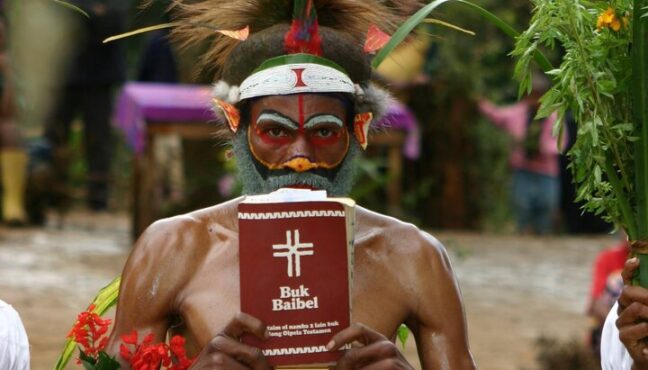
On 12 March 2025, a miraculous event took place in Papua New Guinea (PNG). The nation once known for its extremely harsh treatment of Christian missionaries has now officially declared the country to be a Christian nation, with a special emphasis on the importance of the teachings of the Bible. Furthermore, Papua New Guinea’s parliament amended its constitution to acknowledge “God the Father, Jesus Christ the Son, and the Holy Spirit” in the preamble.
A blighted history of murder and cannibalism
In the nineteenth and twentieth centuries, scores of Christian missionaries were killed in Papua New Guinea. Christ’s teaching of peace and love clashed with the violent spiritual beliefs and practices of the tribes, which included eating the bodies and brains of ‘enemies’ and deceased relatives. Then, during World War 2, the Imperial Japanese armed forces conquered and occupied the country and made the situation considerably worse.
The twentieth century started badly with a number of key incidents making headline news in western newspapers. It began with the murder of James Chalmers and Oliver Tomkins from the Pioneering London Missionary Society. The men were killed and eaten by villagers on Goaribari Island in April 1901.
The 1940s bloodbath
Sporadic killings continued until 1942, which became something of a bloodbath and became known as ‘The Year of The Martyrs of New Guinea’. Hundreds of missionaries including priests, nurses and teachers were brutally murdered. But, astoundingly, the missionaries did not give up. They kept sailing to PNG in substantial numbers, determined to bring the good news to a nation stricken by a deep fear of demons known as khakua and masalai. Alongside the tribal violence and demon worship, missionaries now had to face the brutality of the Japanese Imperial army who worshipped their leader Emperor Hirohito as a living god. Some Christian workers were killed by the tribes and others by the Japanese soldiers with over 330 killed in 1942 alone. This figure included Gona missionaries Rev James Benson, nurse May Hayman, and teacher Mavis Parkinson, all killed by Japanese forces. Anglican and Catholic missionaries Henry Holland, John Duffill, and Vivian Redlich were killed by tribesmen. A number of local Papuan evangelists were also murdered including the popular Lucian Tapiedi.
Martyrs Feast Day
The motives were not often clear, but some early deaths were due to a mix of cultural misunderstandings and resistance from local communities. The Anglican Church observe September 2nd as a feast day for the Martyrs of Papua New Guinea, acknowledging the hundreds of victims of that era. But, as in the New Testament era, the spate of brutal killings did not hinder missionary activity, rather they actually prompted further work. Nowadays these past events are seen as foundational to the growth of the modern Church in Papua New Guinea.
A true Christian Nation
Jesus Christ taught unprecedented and undeserved love and forgiveness. Even as he hung tortured and dying on the cross he prayed aloud, “Father forgive them, they don’t know what they are doing.” (Luke 23:34)
In the New Testament, the Jewish Priest Zechariah prophesied over his newborn son John the Baptist:
“And you, my child, will be called a prophet of the Most High; for you will go on before the Lord to prepare the way for him,to give his people the knowledge of salvation through the forgiveness of their sins, because of the tender mercy of our God, by which the rising sun will come to us from heaven to shine on those living in darkness and in the shadow of death,
to guide our feet into the path of peace.” (Luke 1:76-79)
Jesus spoke about his mission to his followers. John’s gospel records:
When Jesus spoke again to the people, he said, “I am the light of the world. Whoever follows me will never walk in darkness, but will have the light of life.” (John 8:12)
Papua New Guinea was not conquered by military force. Neither did the cult worship of the Japanese Imperial Empire win them over. The heart of the people was eventually won over by Jesus Christ and his followers who shared the message of peace, love and forgiveness, often at the cost of their own lives.
Over 90% of the people of Papua New Guinea now identify as Christian. This radical amendment to the national constitution recognises God the Father, the Son and the Holy Spirit (The Trinity) as the creator, the sustainer, and the source of spiritual authority for the people of Papua New Guinea and declares the Bible to be a powerful symbol of truth, spiritual authority, and moral foundation.
Story by Ralph Burden
Photo: A Christian tribesman proudly carrying his Bible (public domain)
Related Posts
« Elana Meyers Taylor – Faith through trials and triumphs Back from the Dead! Tommy James and the Shondells »


