
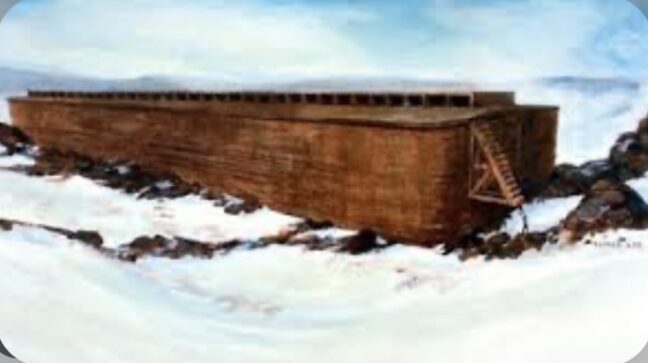
Out of the bloody mayhem of World War One (1914-18) and the onset of the brutal Russian Revolution (1916-18) came widely verified reports that the petrified hull of Noah’s Ark had been located in the Ararat mountain range. These reports came from Russian soldiers loyal to Tsar Nicholas II in 1916.
Despite Leon Trotsky murdering most of the witnesses involved to cover it up, along with the deliberate destruction of photographic evidence and engineers’ drawings, the story has persisted. The atheist Russian Communist leaders were keen to bury the information, but it just would not die. It was passed down by surviving soldiers who had escaped the Communist purge, men who were eye witnesses of the events on the mountain range on the Turkish-Russian border in 1916 together with surviving family members of soldiers killed by Trotsky.
Sherpa George Hagopian
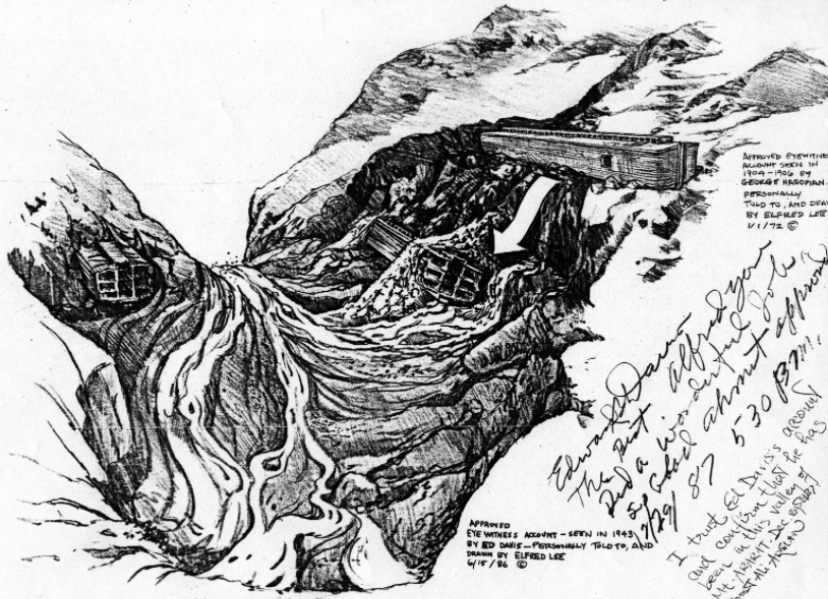
A decade before this in 1906, a young sherpa boy named George Hagopian reported that he had seen Noah’s Ark, well preserved in a deep chasm on Mount Ararat. The report was given by George and his uncle.
Over 60 years later in 1970, archeological illustrator Elfred Lee interviewed George Hagopian who was now living in the United States. Lee considered him to be a very credible eyewitness. Hagopian expressed no desire for fame or money, stating that his only wish was for the Ark to be found. He confirmed the rumours that he had first seen Noah’s Ark on Mount Ararat in 1906 when his uncle took him there. Hogopian and his uncle visited the ship again in 1908. Lee drew accurate sketches from George’s detailed memories of the Ark, which included exterior stairs. George said he needed his uncle’s help to get onto the staircase, which was made more difficult by deep snow and ice.
Reconnaissance flights and the Russian Army expedition of 1916
Areas of the Mount Ararat region were occupied by the Russian army in World War One as part of their Caucasus Campaign. Lieutenant Roskovitsky of the Imperial Russian Army Air Corps was on a reconnaissance flight over Ararat in the spring of 1916 observing Turkish troop movements when he saw what looked like a large barge shaped vessel protruding from the deep ice and snow covering the mountain range.
The report by Lieutenant Roskovitsky said that he noticed a half-frozen lake on a deep gulley that was on the side of Mount Ararat. He was flying a high-altitude test to observe Turkish troop movements. As he flew nearer to the lake, he saw the half submerged hull of a large wooden ship. He also noticed two stubby masts and a flat catwalk along the top.
Roskovitsky told his commanding officer what he had seen. The Captain insisted on flying with him to see the huge ship for himself. The commanding officer was also quite shocked at what they saw and concluded that it must be Noah’s Ark, explaining the reason for its survival must be that “frozen up for nine or ten months of the year, it couldn’t rot, and has been in cold storage, as it were, all this time …. ” Lieutenant Roskovitsky wrote in his report:
“We flew down as close as safety permitted and took several circles around it. We were surprised when we got close to it, at the immense size of the thing, for it was as long as a city block, and would compare very favourably in size to the modern battleships of today. It was grounded on the shore of the lake, with one-fourth underwater. It had been partly dismantled on one side near the front, and on the other side there was a great doorway nearly twenty feet square, but with the other door gone. This seemed quite out of proportion, as even today, ships seldom have doors
Screenshot
even half that large ….”
The Captain seconded Roskovitsky’s conclusions and forwarded the report to St. Petersburg. As a result, Tsar Nicholas II sent two engineering companies to survey the ship. A total of a hundred and fifty men ascended mount Ararat, approaching the structure from two sides. Two weeks of hard work were required to chop out trails along the cliffs of the lower part of the mountain, and it took nearly a month to reach the Ark. Accurate measurements were taken, and plans of the ship were drawn. All of the information was sent to the Tsar.
Cages
The engineers recorded their findings:
“The Ark was found to contain hundreds of small rooms, and some rooms that were very large, with high ceilings. The unusually large rooms had a fence of great timbers across them, some of which were two feet thick, as if designed to hold beasts ten times the size of elephants. Other rooms were also lined with tiers of cages, somewhat like what one sees today at a poultry show, only instead of chicken wire, they had rows of small iron bars along the front. Everything was heavily painted with a waxlike paint resembling shellac, and the workmanship of the craft showed all the signs of a high type of civilisation. The wood used throughout was oleander, which belongs to the cypress family and never rots. This, coupled with the fact of the Ark being frozen all that time, accounted for its perfect preservation.“
Photographic evidence
Alongside the plans, measurements and reports, the investigating officers also sent photographs by courier back to St Petersburg for the personal attention of Tsar Nicholas II. But by the time the documents arrived, Russia was embroiled in civil war. Lenin’s ‘Bolshevik’ Communist militia used all kinds of propaganda and violence to oust the Tzar and set up a rebel government.
Bolshevik propaganda
As the revolution spread, widespread communication breakdown followed. The courier who delivered the records was located and executed along with many of the soldiers who had been on the expedition, But some survived Lenin’s purges and they told their families what they had seen on Mount Ararat. The Communist leaders could destroy the reports and the photographs, but they were unable to find all 150 military engineers and some eyewitness accounts prevailed. Despite countless attempts to silence the discovery, rumours of the expedition persisted.
The New Eden Magazine
In 1939, over two decades later and on the eve of World War Two, a story was printed in the New Eden Magazine in the USA. The story reported on the intriguing discovery witnessed by Lieutenant Roskovitsky. It read,
“At the end of 1916, during a reconnaissance flight above Turkey’s Mount Ararat, Lieutenant Rosovitsky of the Russian Imperial Army allegedly discovered a giant vessel that resembled Noah’s Ark. After this information was reported to Tsar Nicholas II, an expedition consisting of 150 soldiers was sent to the area. According to Roskovitsky, the vessel looked like a combination of a giant barge and commercial train car built from oleander wood, which does not normally rot, but which was additionally preserved in the constant freezing temperatures of the mountain. The length of the barge was equal to about a city block. Inside were lots of separate rooms, large and small. The small ones were surrounded by metal grids which looked like cages. Above the ship, the soldiers discovered numerous logs, which created an impression that timber was lifted to the top of the mountain to build a small dwelling. Very soon after the report of the expedition was presented to Nicholas II the Russian Revolution broke out and no follow-up was possible. Photographs, maps and other documents related to the ark expedition mysteriously disappeared.”
Story by Ralph Burden
Drawings by Elfred Lee
Related Posts
« Back from the Dead! Tommy James and the Shondells Jeremy Doku — “Family comes first” »


